
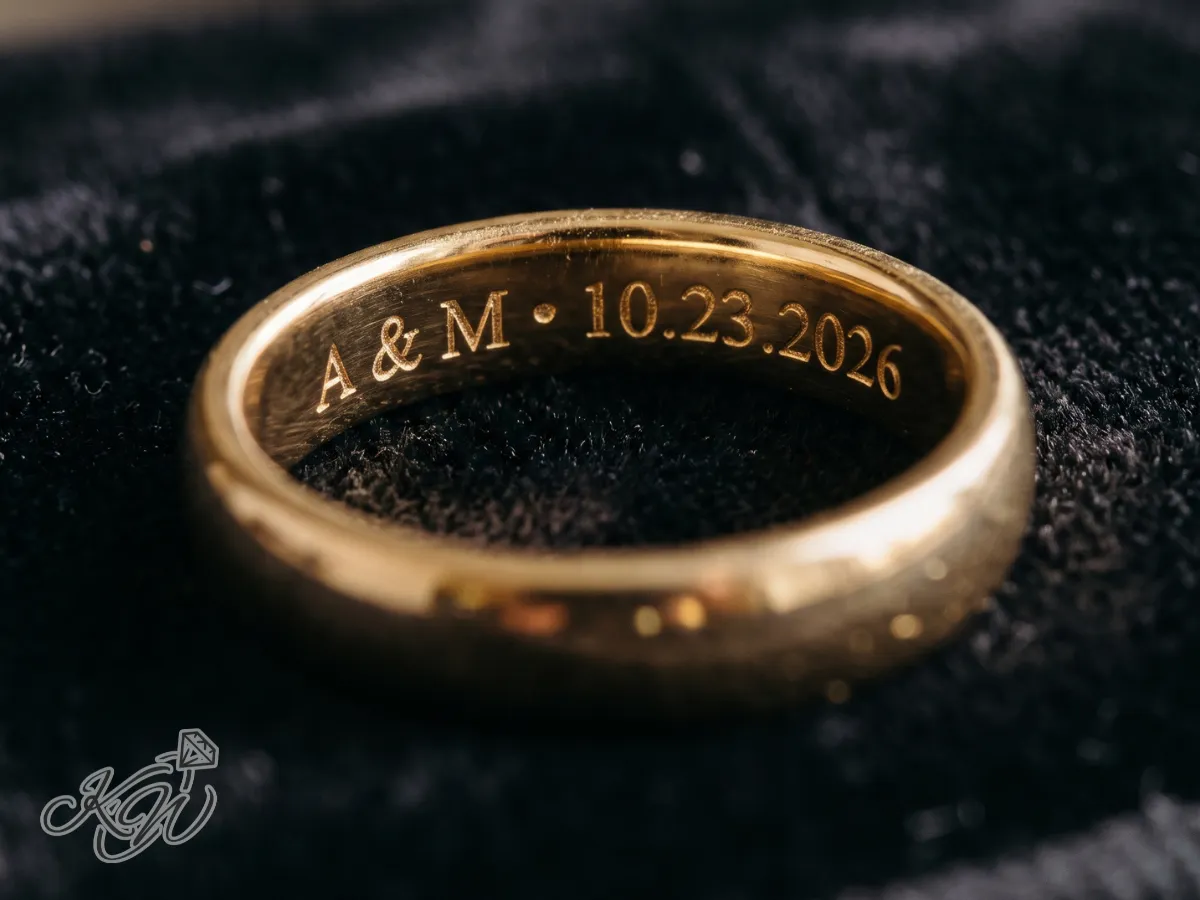
Adding a personal message to a ring transforms a simple band into a family keepsake. Custom Engraving allows you to mark a meaningful milestone directly onto precious metal. Deciding what to stamp inside your band can feel challenging when you have limited space. Dates and initials remain the most enduring options because they carry deep personal meaning without needing long phrases.
Whether you are preparing for a wedding, marking a major anniversary, or resetting a family stone, choosing the right inscription requires attention to detail. You need to consider space, readability, and how the details will look over decades of daily wear. At Ken Walker Jewelers, our team helps you find the right balance between sentiment and clear metalwork. This guide walks you through selecting, formatting, and sizing your dates and initials so your message remains clear for generations.
Key Takeaways
- Space is Limited: Most ring bands comfortably fit between 15 and 30 characters, including spaces.
- Date Formats Matter: Numerical formats (such as 10.14.2025) take up less space than spelled-out months.
- Initial Order: Traditional monograms place the shared last initial in the center, while modern initial pairings use hyphens, ampersands, or plus signs.
- Font Selection: Block and simple serif fonts remain readable on narrow bands longer than ornate scripts.
- Metal Check: Softer metals like high-karat gold may wear down faster inside the shank, requiring clean, deep cuts.
Selecting Significant Dates for Your Band
A date captures a specific moment in time. When selecting a date for your ring, think about the milestone that defines your commitment. Many people assume they must use their wedding date, but several other days hold deep value.
Consider these meaningful date options for your band:
- Wedding Day: The classic choice that marks the official start of your marriage.
- First Meeting or First Date: A private reminder of where your story began.
- Proposal Date: The exact day you decided to build a life together.
- Civil Ceremony Date: Helpful for couples who have a legal ceremony followed by a larger celebration later.
- Child's Birth Date: A thoughtful addition for anniversary bands or family rings.
- Milestone Anniversary: Ideal for couples renewing vows after 10, 25, or 50 years.
Select a date that holds true personal weight for both of you rather than following outside expectations.
Choosing the Right Format for Your Dates
Once you pick the day, you must select a formatting style. Ring shanks provide very narrow real estate. The way you arrange the day, month, and year impacts how clean the text looks inside the finger hole.
Numerical Date Formats
Numerical formats use the least amount of space. They are simple to read and leave room for initials or a small symbol.
- Dots or Periods: 10.24.2025 (Clean, balanced, and modern)
- Slashes: 10/24/2025 (Traditional and clear)
- Hyphens: 10-24-2025 (Crisp and legible)
- Shortened Year: 10.24.25 (Saves two character spaces for narrower rings)
Written Date Formats
Spelling out part of the date creates a softer, more traditional look. Keep in mind that longer month names require a wider band or a larger finger size.
- Standard Written: Oct. 24, 2025
- Formal Full Script: October 24, 2025
- Military or European Order: 24 October 2025
Roman Numeral Date Formats
Roman numerals offer a timeless look. They appear regal and turn a standard date into an interesting pattern.
- Example: October 24, 2025 becomes X.XXIV.MMXXV
- Space Warning: Roman numerals use many characters. For instance, the number 28 is XXVIII (six characters instead of two). Make sure your ring circumference has enough room before finalizing this style.
Pro Tip: If your ring band is under 2 millimeters wide, stick to numerical dates with periods. Dots take up less vertical room than slashes and keep the numbers legible.
How to Monogram and Format Initials
Initials offer a subtle way to represent your bond. Depending on your personal taste, you can arrange initials in several ways.
Here are the primary initial configurations:
- Two Initials with a Connector
- A + B (Modern and casual)
- A & B (Classic and balanced)
- A • B (Minimalist with a centered dot)
- A + B = Love (Playful, if space allows)
- First Names Combined with Last Name Initial
- For a couple sharing a last name, format it as J & M Smith or simply J & M S.
- If keeping separate names, combine both first initials: J + M.
- Traditional Three-Letter Monograms
- In traditional monograms, the shared surname initial sits in the center in a larger size: First initial on the left, last name initial larger in the center, partner's first initial on the right.
- Example: For John and Mary Miller, the monogram appears as J M M.
- On a thin ring, size variations can be hard to see, so equal-sized initials separated by periods (J.M.M.) often work better.
- First Names Only
- If initials feel too brief, you can spell out short first names: Sarah & David.
- Make sure your jeweler checks the letter count against your finger size first.
Popular Layout Combinations for Names and Dates
Combining both initials and dates gives you a complete record of your milestone. Because the inside of a ring is private, you can keep it formal or make it uniquely yours.
Review these balanced pairing ideas:
- Initials First, Date Second: S & T | 06.12.2026
- Date First, Initials Second: 12.04.25 • J + K
- Locations Combined: NYC • 09.18.24 (Great if you got engaged in a specific city)
- Coordinates and Initials: 47°N 122°W — M + R
- Infinity Symbols: A & B ∞ 10.15.25
Technical Factors: Fonts, Width, and Metal Choice
A design may look great on paper, but the physical ring determines what is practical. Physical size, metal properties, and font styles dictate the final result.
+-------------------------------------------------------------+
| INSCRIPTION SPACE CHECKLIST |
| |
| [ ] Measure band width (Minimum 1.5mm recommended) |
| [ ] Count total characters (Letters + Numbers + Spaces) |
| [ ] Confirm ring size (Sizes under 5 have shorter shanks) |
| [ ] Check for maker stamps and metal quality marks |
+-------------------------------------------------------------+
Font Selection
The font you select directly influences clarity. As fingers age and rings undergo regular cleaning, clean lines hold up best.
- Block / Sans-Serif (e.g., Arial, Helvetica style): The easiest to read on any width. Excellent for small rings under 2.5 millimeters.
- Classic Serif (e.g., Times style): Formal and traditional. Works best on bands 3 millimeters or wider.
- Script or Cursive: Flowing and romantic. However, the script requires more height. On narrow bands, cursive letters can run together and look messy.
Band Width and Ring Size
The physical surface inside the ring sets clear limits:
- Finger Size: A size 11 ring has far more surface area inside than a size 5 ring.
- Width: Bands wider than 3 millimeters can handle two lines of text or larger script letters. Bands below 2 millimeters need short, single-line text in clean block lettering.
- Hallmarks: Jewelers must leave room for metal stamps (such as 14K, 18K, or PLAT) and maker marks. Your text cannot overlap these official stamps.
Metal Hardness and Inscription Methods
The type of metal inside your band affects how text is placed:
- Platinum: Dense and durable. Holds crisp machine lines without shifting.
- Yellow and White Gold: Soft enough for clean cutting, but subject to long-term wear from skin friction. Letters should be cut deep enough to last.
- Titanium, Cobalt, and Tungsten: Extremely hard metals that cannot be stamped with manual tools; they require specialized laser machinery.
Comparison of Common Inscription Formats
Use the comparison table below to determine which layout matches your ring dimensions and style preference.
|
Inscription Style |
Example Text |
Character Count |
Best Band Width |
Readability Rating |
|
Simple Numeric Date |
05.18.2025 |
10 |
1.5mm or wider |
Very High |
|
Initials with Symbol |
T & M |
5 |
1.5mm or wider |
Very High |
|
Initials Plus Short Date |
D + K 08.12.25 |
14 |
2.0mm or wider |
High |
|
Written Month & Year |
June 14, 2025 |
13 |
2.5mm or wider |
High |
|
Roman Numeral Date |
VII.XII.MMXXV |
12 |
3.0mm or wider |
Medium |
|
Names and Full Date |
Mark & Lisa 09.20.25 |
20 |
3.5mm or wider |
Medium |
|
Traditional Monogram |
R B S |
5 |
3.0mm or wider |
Medium (Depends on font) |
Frequently Asked Questions
How many characters can fit inside a standard wedding band?
Most rings accommodate between 15 and 30 characters. This count includes spaces, punctuation, and symbols. If you have a small finger size (under size 6), aim for 15 to 20 characters so the text does not crowd the structural hallmarks.
Can an inscription be changed or removed later?
Yes. If your ring is made of gold or platinum, a jeweler can buff out the inscription and polish the inner surface flat. Keep in mind that removing metal repeatedly can thin the shank. Laser marks can also be polished away and redone if you need to update a date.
Will resizing my ring damage the inside text?
Resizing can affect text if the jeweler cuts directly through the letters to add or remove metal. Always tell your jeweler that your ring contains an inner inscription. They will make every effort to cut away from the lettering, though long inscriptions that wrap around the entire band may need partial re-cutting after resizing.
Should both partners have matching inscriptions?
There are no strict rules. Some couples choose identical dates and initial layouts. Others prefer complementary messages, where one ring has the initials A to B and the other reads B to A. Choose whatever feels most natural to you both.
What should I check before ordering my custom text?
Always double-check spelling, spacing, and numbers on paper before authorizing the work. Verify that your partner uses the standard American month-day-year format if they grew up using day-month-year, so there is no confusion down the road.