
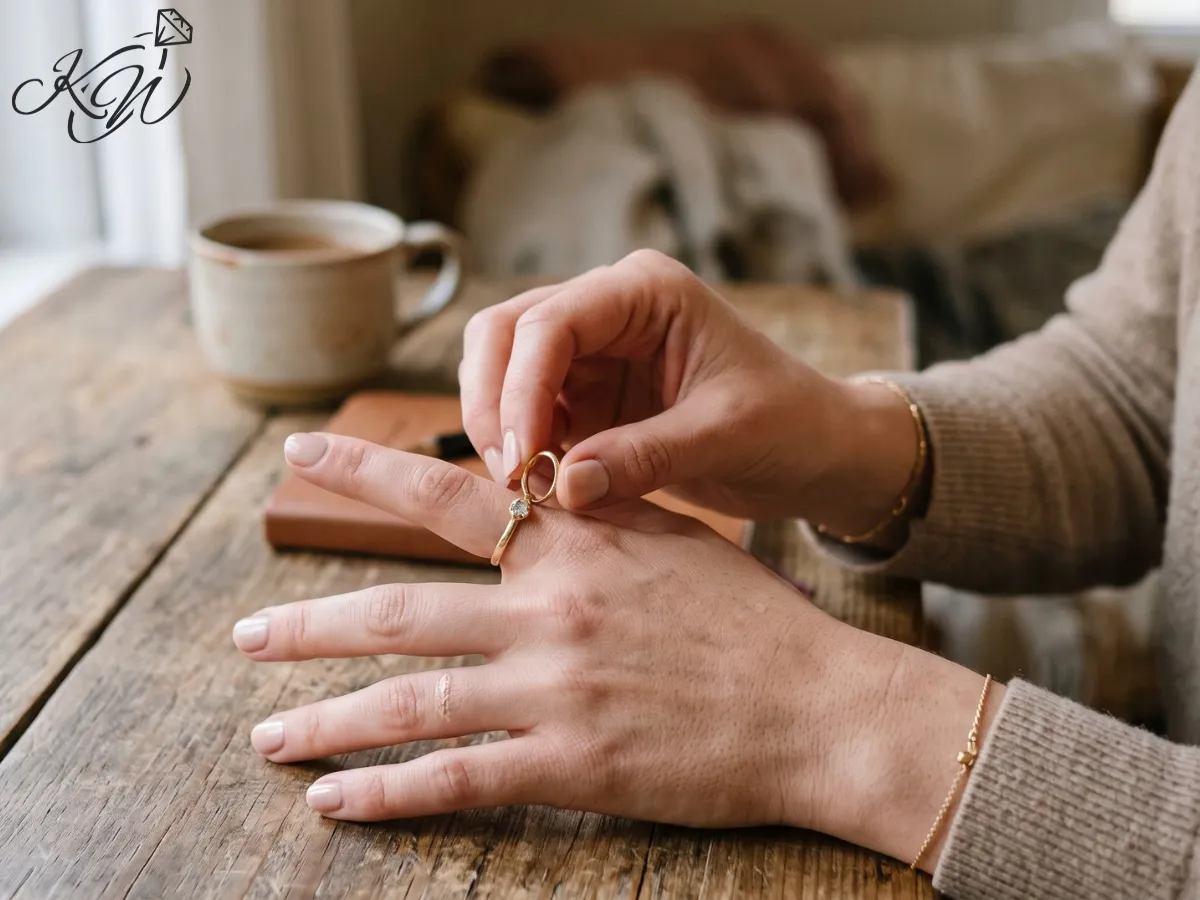
Finding the right balance for your ring can feel tricky. You want your ring to slide on easily, but you do not want it falling off when you wash your hands. True fit & comfort means your ring stays securely in place without squeezing your skin or causing irritation. At Ken Walker Jewelers, we believe wearing your favorite piece should feel as natural as possible every single day.
Key Takeaways
- A proper fit means the ring slides over your knuckle with light resistance and comes off with a firm pull.
- Temperature, hydration, salt intake, and time of day make your fingers swell or shrink.
- Wider bands feel tighter than thin bands, even at the exact same size.
- Never force a ring off if your finger swells; use cool water and mild soap instead.
- Professional sizing gives you the most reliable measurement for long-term comfort.
The Golden Rule of Ring Sizing
How should a ring actually feel on your finger? As a standard rule of thumb, your ring should slide smoothly over your knuckle when you put it on. When you take it off, you should feel a little resistance. It should require a gentle, twisting pull to slide over the knuckle on the way off.
If your ring spins freely every time you move your hand, it is likely too loose. On the other hand, if your ring leaves a deep red mark or makes your finger throb, it is too tight.
Here are three simple checks you can do right now:
- The Shake Test: Wash your hands with cool water and gently shake your hand over a soft towel. If the ring slips past the knuckle, it is too loose.
- The Turn Test: Try spinning the ring around your finger. It should rotate without catching your skin, but it should not spin completely on its own weight.
- The Skin Pinch: Look at the skin on either side of the band. If your skin billows over the metal, the band is squeezing too hard.
Signs Your Ring Is Too Tight
Wearing a tight band does more than create discomfort. Over time, it can trap moisture, irritate your skin, or even limit blood flow.
Watch for these clear signs that your band needs a little extra room:
- Tingling or numbness: Your finger should never feel numb, cold, or tingly. These are signs of restricted circulation.
- Muffin-top effect: If skin bulges noticeably over the edges of the band, the ring is choking the finger.
- Painful removal: You should not need lotion, soap, or dental floss every time you take your jewelry off.
- Redness and indentations: While a faint impression is normal after hours of wear, deep red rings or chafing mean the piece is too small.
- Trapped water rash: When a band is too tight, soap and water become trapped underneath, leading to skin rashes known as "wedding ring rash."
Pro Tip: If your ring ever gets completely stuck, stay calm. Do not yank it. Raise your hand above your shoulder for three minutes to reduce blood pooling, coat the finger in cold soapy water, and twist the band off gently.
Signs Your Ring Is Too Loose
A loose ring brings constant worry. You might find yourself checking your hand every five minutes to confirm the ring is still there.
Look out for these symptoms of a loose fit:
- Constant spinning: Heavy center stones tend to flop to the palm side of your hand if the band does not hold its position.
- Flying off with gestures: If you talk with your hands and feel the band shift forward, you are at risk of losing it.
- No knuckle drag: The band comes off with zero effort, sliding right off when your hand is tilted downward.
- Clicking against objects: When you grip a steering wheel or grocery bag, the ring feels wobbly or clatters against hard surfaces.
Daily Factors That Change Your Finger Size
Your fingers do not stay the exact same size throughout the day. In fact, a finger can fluctuate by half a size or more due to normal biological and environmental factors.
Weather and Temperature
Your body reacts quickly to the climate around you:
- Cold weather: Blood vessels constrict to keep your core warm, making your fingers shrink. Rings will feel looser in winter.
- Hot weather: Heat causes blood vessels to expand, leading to natural swelling. Rings feel noticeably tighter in summer.
Diet and Physical Activity
What you eat and do during the day shapes your size:
- Sodium intake: High-salt meals cause water retention, leading to puffy fingers the next morning.
- Exercise: Workouts pump extra blood to your extremities, temporarily increasing your finger size.
- Hydration levels: Dehydration can actually cause your body to hold onto fluids, resulting in unexpected swelling.
Time of Day
- Morning: Many people wake up with slightly swollen fingers after lying flat all night.
- Evening: By late afternoon, walking and daily movement regulate fluid levels, making this the best time to check your true ring size.
Quick Guide: Tight vs. Loose vs. Ideal Fit
Use this quick reference table to evaluate how your ring behaves throughout the day.
|
Feature |
Too Tight |
Ideal Fit |
Too Loose |
|
Putting It On |
Catches hard at the knuckle; needs force |
Slides on smoothly with light guidance |
Falls onto the finger with no contact |
|
Taking It Off |
Requires soap, ice, or extreme pulling |
Needs a gentle, deliberate pull and twist |
Slides off freely when hand points down |
|
Movement |
Cannot turn or shift at all |
Turns with light pressure from your other hand |
Spins freely on its own weight |
|
Finger Markings |
Deep red grooves, irritated skin, or swelling |
Soft, temporary mark that fades quickly |
No mark at all; leaves open gaps |
|
Comfort Level |
Throbbing, pinching, or trapped moisture |
You forget you are wearing it |
Constant worry of losing the piece |
The Knuckle Factor: A Common Fitting Challenge
Not all fingers are shaped the same way. One of the most common fitting hurdles involves knuckles that are significantly wider than the base of the finger.
If you size the ring to fit past the knuckle, it ends up spinning around the base. If you size it for the base, you cannot slide it past the knuckle.
Here are practical solutions for large knuckles:
- Sizing beads: A bench jeweler can solder two tiny metal bumps inside the back of your band. They hold the ring upright on the slim part of your finger while letting the knuckle slide through.
- Spring inserts: A horseshoe-shaped metal spring rests inside the shank. It flattens as the ring goes over your knuckle and springs back to hug your finger base.
- Hinged shanks: For severe differences, a jeweler can build a custom shank that opens with a discreet clasp, bypassing the knuckle entirely.
Key Insight: At Ken Walker Jewelers, we see this often. Sizing beads are one of the simplest, most cost-effective ways to stop a top-heavy ring from spinning without changing the official ring size.
Ring Width and Its Effect on Daily Wear
The style of the band plays a massive role in how size feels. A thin, delicate band covers very little surface area, so it slides easily over the skin. A wide cigar band or a stack of multiple rings displaces more skin, creating much more friction.
Keep these rules in mind when picking your ring style:
- Bands under 2mm: Thin bands fit loosely. You might need to go down a quarter size for a secure hold.
- Bands between 2mm and 4mm: This is the standard width for most jewelry. True-to-size measurements work best here.
- Bands wider than 6mm: Wide bands trap more air and skin. You will often need to size up by a quarter to a half size to maintain your comfort.
- Ring Stacks: When you stack three or four thin rings together, they behave like one wide band. Plan to size up slightly if you wear stacked sets.
Professional Sizing vs. DIY Sizing Methods
You may have seen tips online suggesting you measure your finger using a strip of paper, a piece of string, or a tape measure. While these tricks sound convenient, they rarely deliver accurate results.
Why DIY Sizing Often Fails
- String stretches: Yarn and string stretch when pulled, giving you a measurement that is too large.
- Paper does not bend like metal: Paper creases and tears, failing to capture the three-dimensional curve of a solid metal band.
- Zero knuckle clearance: Wrapping paper around the base of your finger ignores the knuckle, meaning the finished ring may not even slide on.
How Professional Jewelers Measure
When you visit a family-owned jeweler like Ken Walker Jewelers, we use precise sizing rings made of real metal.
- We test both narrow and wide sizes depending on the design you want.
- We check your hands at different times or suggest stopping in after work when your hands are at their average size.
- We factor in your personal lifestyle, hobbies, and work environment.
Temporary Solutions for Loose Rings
If your ring feels loose because of cold weather, seasonal weight changes, or pregnancy recovery, you might not want to cut and resize the metal just yet. Permanent resizing removes metal, and doing it repeatedly can weaken the band over time.
Consider these temporary options instead:
- Plastic ring snuggies: These are clear silicone coils that wrap around the bottom of the band. They are soft, budget-friendly, and easy to remove.
- Clip-on metal guards: Small metal strips fold around the inside of the shank. These can adjust fit quickly, though they should be installed carefully to avoid scratching the metal.
- Stacking a tighter band: Placing a thin, snug band on the outside of your loose ring acts as a stopper, keeping the main ring safely in place.
Frequently Asked Questions
How do I know if my ring fits properly?
Your ring fits well when it slides over your knuckle with light effort and requires a gentle pull to remove. It should sit comfortably without pinching your skin or spinning continuously.
Can any ring be resized?
Most gold, platinum, and silver rings can be resized easily. However, rings made from alternative metals like tungsten, titanium, or stainless steel cannot be resized. Rings with diamonds running entirely around the band, such as full eternity bands, are also difficult or impossible to resize without rebuilding the piece.
How much can a jeweler change a ring size?
Most traditional rings can safely go up or down by two full sizes. Changing a size beyond that range can loosen stone settings or distort the circular shape of the band.
Should my ring feel tighter in the summer?
Yes. Warm temperatures and humidity cause your blood vessels to expand, which naturally swells your fingers. A ring that fits comfortably in July might feel a bit loose in January.
Why does my ring leave a green or dark mark if it is not too tight?
Dark marks are usually caused by a chemical reaction between the metals in your ring, skin oils, and hand lotions or soaps. While tightness makes the reaction more visible by pressing the metal firmly against the skin, discoloration usually comes from product buildup rather than size alone.
Caring for Your Rings at Ken Walker Jewelers
Getting your ring size right should be an enjoyable, low-stress experience. For 52 years, Ken Walker Jewelers has helped our community celebrate life milestones with honest advice, quality work, and fair pricing. Whether you need a quick measurement, a simple repair, or sizing beads added to an heirloom piece, our team is here to help you wear your jewelry with confidence.
Stop by Ken Walker Jewelers today to have your rings checked and sized by our friendly team. We will help you find the right fit so your favorite jewelry feels secure and comfortable every day.